iPhone Duo durability: hinge design, patents and unknowns
iPhone Duo durability, checked: what Apple built into the hinge, which fixes exist only as patents, and what a reported 60% assembly yield can't tell you.
Source-based. Written from the documents, reporting and reviews linked in the text. Nothing here was tested hands-on by The Ruling Desk. How we work
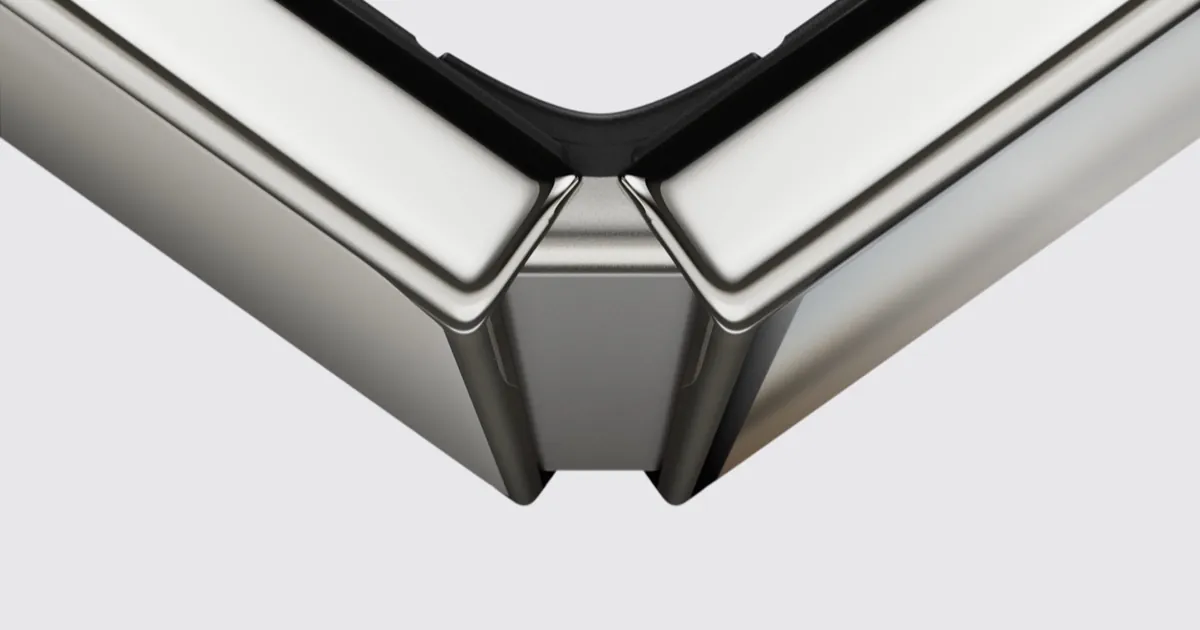
Apple announced the iPhone Duo on September 9 and set its release for October 23, a 44-day wait that's more than four times Apple's usual gap. Supply-chain reports tie that wait to the hinge and the folding screen, which raises the obvious question about iPhone Duo durability. Here's what Apple says it built into the hinge, what exists only in its patents, what a reported 60% assembly yield does and doesn't tell you, and what nobody can know yet.
Key takeaways
- Apple gave the October 23 date on announcement day, so the 44-day wait (against 9 to 11 days for the last six Pro iPhones) is a long scheduled gap, not a missed Apple promise. Apple hasn't explained it.
- Supply-chain reports point at the hinge and the folding panel. Jiemian News puts Foxconn's final assembly yield at "only over 60%". That's a factory number; it says nothing about how the phones that ship will hold up.
- Apple says the hinge has more than 100 parts and the inner screen has a stiffer polymer cover layer over a titanium plate, with an IP68 rating. It publishes no fold-count rating.
- The screen heater, drop folding and self-healing ideas in Apple's patents appear in nothing Apple has announced. Our patent table below gives each record's status as checked on September 23, 2026.
- Long-term durability is unknown: no Duo has reached a customer, so there is no field data yet.
Why the iPhone Duo launch took 44 days
For five years, Apple's flagship iPhone reached stores about ten days after the keynote. The iPhone 18 Pro, announced on the same stage as the Duo, kept that pace. The Duo didn't.
| iPhone | Announced | On sale | Days |
|---|---|---|---|
| iPhone 13 Pro | Sept 14, 2021 | Sept 24 | 10 |
| iPhone 14 Pro | Sept 7, 2022 | Sept 16 | 9 |
| iPhone 15 Pro | Sept 12, 2023 | Sept 22 | 10 |
| iPhone 16 Pro | Sept 9, 2024 | Sept 20 | 11 |
| iPhone 17 Pro | Sept 9, 2025 | Sept 19 | 10 |
| iPhone 18 Pro | Sept 9, 2026 | Sept 18 | 9 |
| iPhone Duo | Sept 9, 2026 | Oct 23 | 44 |
Dates come from Apple's newsroom posts for each launch, including the iPhone Duo announcement. That same announcement set pre-orders for October 16 and availability for October 23, so the Duo hasn't slipped past a date Apple committed to. The gap was planned from day one; it's only late compared with Apple's usual rhythm.
Apple hasn't said why the gap is so long. Supply-chain reporting offers an explanation, covered next. Treat it as the reporters' account from unnamed industry sources, not as Apple's.
iPhone Duo production problems: the 60% yield and the hinge shuffle
On September 17, Jiemian News reported, citing people close to Foxconn's supply chain, that the "overall yield rate of Foxconn's assembled iPhone Duo units is only over 60%" (English version on 36Kr, published September 21). The same report says the "delayed launch" was "first affected by the delivery pace of core components such as foldable OLED panels and hinges". It adds that yield "may take another half a year or even a full year" to mature, that the first batch is small, and that Apple's global stocking target for this year is about 6 to 8 million units.
Assembly yield is not a failure rate
Yield is a factory figure: the share of assembled phones that pass final checks on the line. A unit that fails is fixed or set aside at the factory, not sold as is. So a 60% yield means roughly four in ten Duos don't pass on the first try, which makes the phone slow and costly to build and limits supply. It does not mean four in ten phones you can buy will fail. That second question, the field failure rate, is how many sold phones later develop hinge or screen faults, and no one has that data yet.
The hinge supplier switch
The hinge is where most of the reported trouble sits. ZDNet Korea reported in June, citing an industry source, that Taiwan's Shin Zu Shing had become the first hinge supplier ahead of Amphenol, because Amphenol's yield was even lower than Shin Zu Shing's. A September 11 follow-up, summarized by MobiDevices, said Shin Zu Shing still can't steadily make enough parts that meet Apple's requirements, and that only units that do, which the industry calls "golden samples", go on to Foxconn.
Jiemian adds that Samsung Display and hinge part makers earlier ran into low yields, late deliveries and design changes. Analyst Jeff Pu then cut his 2026 forecast from 7 million to 6 million units, which 9to5Mac attributes to "hinge constraints", not a lack of demand.
Who builds what, according to supply-chain reports (Apple names no suppliers):
- Samsung Display: the foldable OLED panel, per Jiemian and a Yicai report summarized by MacDailyNews.
- Shin Zu Shing and Amphenol: hinge assemblies, as first and second supplier, per ZDNet Korea.
- Lens Technology: main supplier of the ultra-thin glass, with BIEL Crystal also making cover plates, per the same Yicai report.
- Lingyi iTech and Eontec: hinge parts and support plates from Lingyi, Liquidmetal hinge spindles from Eontec, also per Yicai.
- Foxconn: final assembly, per Jiemian.
iPhone Duo durability: what Apple built into the hinge
Apple's own claims are narrower than the rumors, but concrete. From its announcement, Apple says:
- The iPhone Duo hinge is "engineered from more than 100 components" and pairs with a magnet array for a secure close.
- The hinge cover is 3D-printed from 100 percent recycled titanium.
- The inner screen's nano-textured cover layer is a custom polymer "with up to 40 percent higher stiffness than other materials used in the industry."
- Custom adhesives let the display layers "glide past one another like the pages of a book, relieving bend stress", with a titanium plate underneath.
- Ceramic Shield 2 covers the front, Ceramic Shield the back, the frame is grade 5 titanium, and the phone is rated IP68.
Tom Marieb, Apple's vice president of hardware engineering, told TechRadar that the team "really worked on the torque profile very heavily" so the hinge feels solid, "like a high-end automobile's car door" (summary at 9to5Mac). That describes how the hinge should feel, not how long it lasts: neither he, the announcement nor the spec sheet gives a fold-count or hinge-cycle rating, as checked on September 23, 2026. What early reviewers said about the crease is collected in our iPhone Duo price, specs and early impressions guide.
What Apple doesn't mention anywhere: a screen heater, a cold-weather lock, self-healing or drop detection. The spec sheet lists an operating range of 32° to 95° F (0° to 35° C), the same as other iPhones.
Apple foldable patents: ideas it owns, not features you get
A patent tells you what a company thought was worth protecting, not what's in the box. Four Apple filings come up whenever the Duo's durability is discussed, and only three say what they're claimed to say. A fifth, much older one shows how far back Apple's hinge work goes.
We opened each record on Google Patents on September 23, 2026. The status column is what those records show; Google Patents notes that its legal status is an assumption, not a legal conclusion.
| Patent | Proposed function | Status as checked | Shipping in the Duo? | Source |
|---|---|---|---|---|
| US20250365904A1 | Heats the folding screen's cover in the cold; can lock the hinge below a temperature threshold | Published application, not granted; notice of allowance mailed May 13, 2026 | None found | Google Patents |
| US12169422B2 | Senses a fall and partly folds the phone so the frame lands first | Granted December 17, 2024; listed as active | None found | Google Patents |
| US11991901B2 | Self-healing layer in a flexible display cover | Granted May 21, 2024; listed as active | None found | Google Patents |
| US11353933B2 | Notebook screen that tilts itself toward you, using shape-memory alloy and a camera | Granted June 7, 2022; listed as active | Not a phone feature; none found | Google Patents |
| US5987704A | Dual-axis laptop hinge with gears and brakes | Granted November 23, 1999; listed as expired | Not a Duo feature | Google Patents |
"None found" means none of these functions appears in Apple's announcement or on the spec sheet as of September 23, 2026.
A screen heater for cold weather
Application US20250365904A1, "Flexible Displays with Heating Elements", was filed in May 2024 and published in November 2025. It hasn't been granted: its record shows a notice of allowance mailed on May 13, 2026, meaning an examiner approved it, but no patent number has been issued. A transparent conductive layer, such as indium tin oxide, silver nanowires or a metal mesh, heats the display's cover based on a measured temperature, softening its polymer layers and smoothing wrinkles. It also describes restricting the hinge when a sensor reads below a temperature threshold. Y.M. Cinema summed up the problem it targets: "In cold weather the polymers stiffen, the cover layer loses flexibility."
A phone that folds itself before it lands
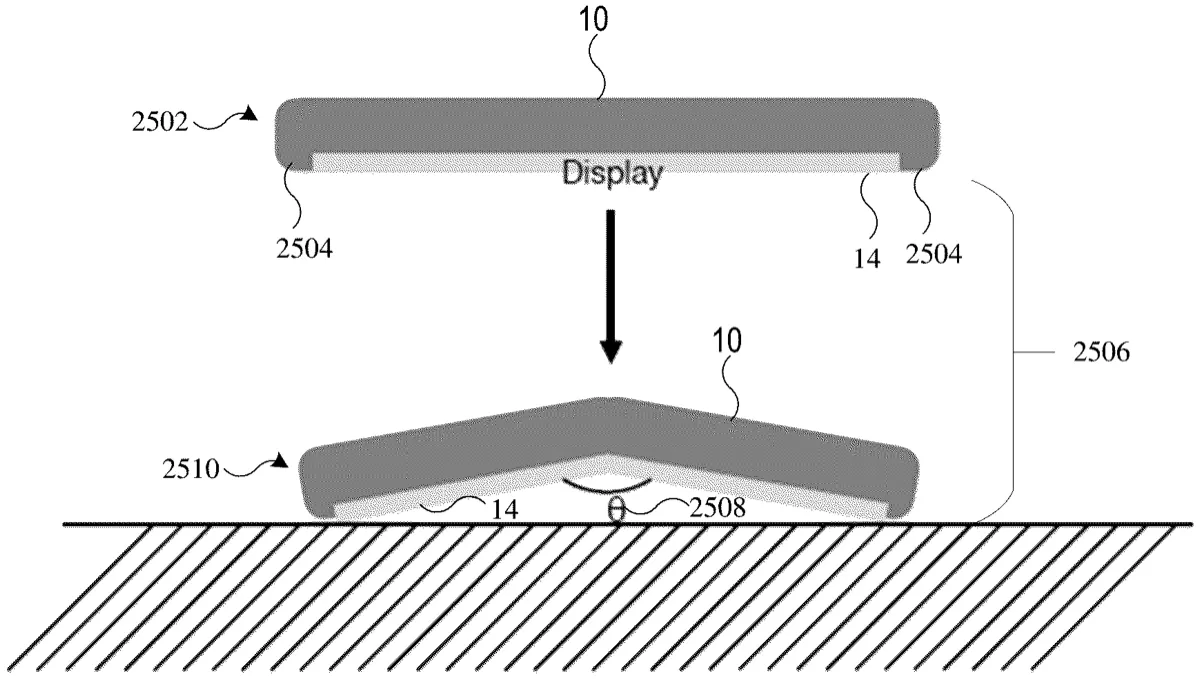
US12169422B2, granted in December 2024, describes a foldable that senses a fall from its vertical acceleration. Motorized hinges or spring-loaded detents then partly close the display, so the frame hits the ground instead of the screen.
A cover layer that heals
US11991901B2, granted in May 2024, adds a self-healing layer to a flexible display cover to reduce dents and scratches. Healing can be started or sped up by heat, light or electric current, and one version heats the layer while the device charges.
The one that gets misread
US11353933B2 is often cited as a shape-memory-alloy hinge that locks in the cold. It isn't. It describes a notebook computer whose shape-memory-alloy actuator tilts the screen toward your face, guided by a camera. It says nothing about temperature thresholds or phones.
Apple's hinge patents go back to 1998
The oldest link people cite is US5987704A, "Dual axis hinge apparatus with braking mechanism". Apple Computer filed it in April 1998, and it was granted in November 1999; Google Patents now lists it as expired. It's a laptop hinge built from two meshing gears and deformable brakes, not a folding-phone prototype. What it does show is that Apple has been patenting hinges since at least 1998, 28 years ago.
Patentlyze, which tracks Apple's newer foldable filings, reads the trail this way: "Together the filings show Apple working through the mechanical and display problems that separate a folding concept from a device people can actually use." That's the fair reading: a record of problems Apple worked on, not a list of features in the phone.
What it means for you
- Expect tight supply. Pre-orders open October 16, Jiemian reports a small first batch, and Pu's forecast is falling. If you want one on day one, order early.
- Buy on what Apple promises. That's IP68, titanium, Ceramic Shield 2 and the stiffer cover layer. Don't count on a heated screen, drop folding or self-healing.
- Don't read the 60% as a breakage rate. It's a reported factory yield. It tells you the Duo is hard to build, not how often a phone you buy will fail.
- Cold climates get no special treatment. Nothing in the spec sheet says the Duo handles cold better than any other iPhone.
- Long-term iPhone Duo durability is unknown. The phone isn't on sale yet, so there's no data on how the hinge and screen hold up after months of use.
On price, the Duo starts at $1,999 in the US, per Apple's announcement. Storage tiers and full specs are in our price and specs guide.
Bottom line
Apple set the Duo's October 23 date on day one, so the phone isn't late against any promise, just far later than a normal iPhone. Apple hasn't said why. Supply-chain reports point to manufacturing difficulty, mainly the hinge: a reported 60% assembly yield, a hinge supplier switch and hand-picked golden samples. That's the best-supported explanation available, but it's an inference from those reports, not something Apple has confirmed.
What Apple ships is a carefully tuned hinge and a stiffer matte cover layer, backed by IP68 and no published fold rating. The heater, the drop fold and the self-healing screen are patents, and may never ship. How the hinge and screen hold up over months is unknown until owners have them: a factory yield is not a field failure rate.
If you want one on October 23, be ready when pre-orders open. If durability is your main worry, wait for long-term reviews. For how the Duo stacks up against a cheaper rival, read our iPhone Duo vs Xiaomi 18 Fold comparison, and find more phones in Gadgets.
Updated September 23, 2026: the manufacturing explanation for the launch gap is now labeled as an inference from supply-chain reports, a patent status table is added, and three details are fixed, as listed on the Corrections page.
FAQ
Is the iPhone Duo durable?
Nobody knows yet. Apple says the hinge uses more than 100 components, the frame is grade 5 titanium, and the phone is rated IP68, but it publishes no fold-count rating. The phone goes on sale October 23, so real-world wear will take months to show.
Why did the iPhone Duo take so long?
Apple hasn't said. Supply-chain reports point to the hinge and the folding panel: low hinge yields reportedly led Apple to change its first hinge supplier, and Jiemian News reports Foxconn's final assembly yield at just over 60%. The October 23 date itself was announced on September 9, so it's a long planned gap, not a missed date.
Will the iPhone Duo be hard to get at launch?
Probably. Jiemian News reports a small first batch, and analyst Jeff Pu cut his 2026 forecast to 6 million units because of hinge constraints, according to 9to5Mac. Pre-orders open October 16.