iPhone Duo: price, specs, release date and early reviews
iPhone Duo price in the US and Mexico, checked against Apple's stores, plus the official specs, release dates and what early hands-on reviewers reported.
Source-based. Written from the documents, reporting and reviews linked in the text. Nothing here was tested hands-on by The Ruling Desk. How we work
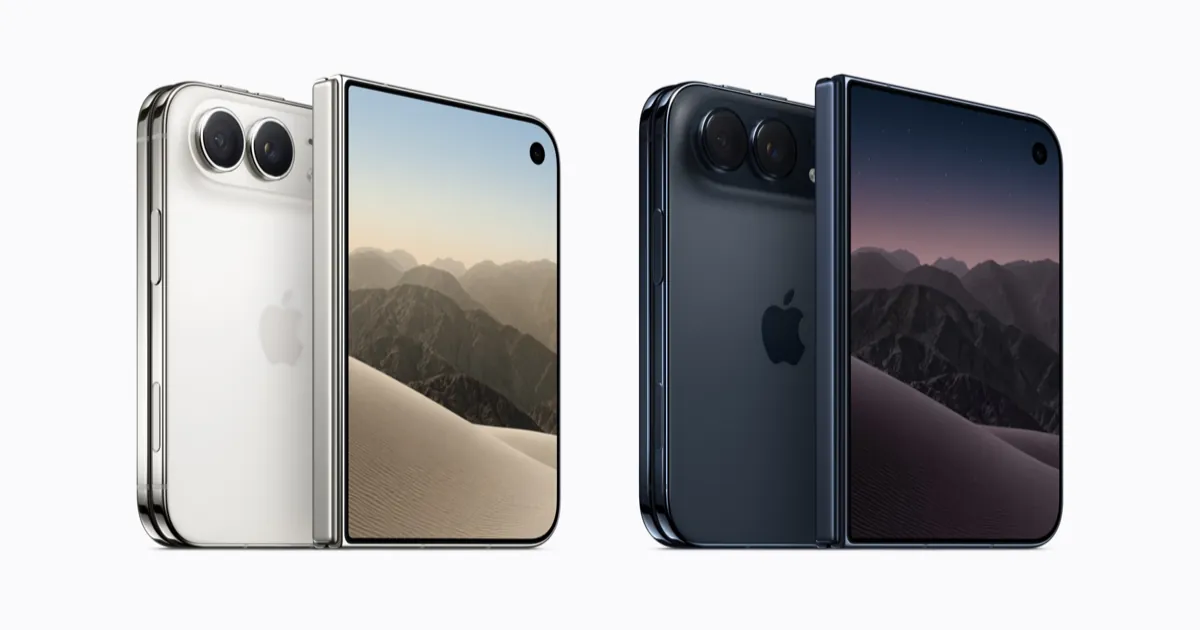
The iPhone Duo, Apple's first foldable, is a book-style phone that opens into a 7.6-inch screen, starts at $1,999 in the US and goes on sale October 23. This is a researched overview of the iPhone Duo price, specs and release date, built from Apple's own pages and the early impressions of reviewers who handled the phone for a short time at Apple's event. We haven't used one, and as of September 23, 2026 we found no full review published.
Key takeaways
- In the US, the iPhone Duo costs $1,999 for 256GB up to $3,199 for 2TB. In Mexico it's MXN 47,999 to MXN 77,999. Both come from Apple's online stores, as checked on September 23, 2026.
- Pre-orders open October 16 and sales start October 23 in more than 70 countries, the US and Mexico among them, according to Apple.
- Reviewers who handled it briefly say the matte inner screen hides the crease well (better than Samsung does, in MacRumors' view), but they could still see it at some angles. How the hinge and crease hold up over time is untested.
- Touch ID in the side button replaces Face ID. The inner selfie camera sits under the screen, and Apple hasn't said its resolution.
- Battery claims are Apple's own: up to 31 hours of video on the big screen, from Apple's tests on preproduction units. We found no independent battery test yet.
iPhone Duo price and release date
Apple announced the phone at its September 9 event. Pre-orders open Friday, October 16, and the phone reaches stores on Friday, October 23 in more than 70 countries and regions, including the US, Mexico, Brazil and Colombia, with 28 more following on October 30, according to Apple's announcement. The same announcement says it ships with iOS 27.1.
It comes in two colors, Star White and Night Sky, and four storage sizes. Here is what Apple's own stores charged for each one when we checked:
| Market | Currency | Storage | Price | Source | Checked |
|---|---|---|---|---|---|
| United States | USD | 256GB | $1,999 | Apple US store | Sep 23, 2026 |
| United States | USD | 512GB | $2,199 | Apple US store | Sep 23, 2026 |
| United States | USD | 1TB | $2,599 | Apple US store | Sep 23, 2026 |
| United States | USD | 2TB | $3,199 | Apple US store | Sep 23, 2026 |
| Mexico | MXN | 256GB | MXN 47,999 | Apple Mexico store | Sep 23, 2026 |
| Mexico | MXN | 512GB | MXN 52,999 | Apple Mexico store | Sep 23, 2026 |
| Mexico | MXN | 1TB | MXN 62,999 | Apple Mexico store | Sep 23, 2026 |
| Mexico | MXN | 2TB | MXN 77,999 | Apple Mexico store | Sep 23, 2026 |
US prices are before sales tax. Apple's Mexico store says its prices include 16% IVA, and it lists pre-orders from 6:00 a.m. Mexico City time on October 16. MacRumors' hands-on reported the same $3,199 for 2TB on launch day. We only list markets we could check on Apple's own store; prices elsewhere are not verified here. Apple also sells a $79 two-part case and a $129 Folio with a built-in kickstand in the US.
iPhone Duo specs at a glance
| iPhone Duo | |
|---|---|
| Inner screen | 7.6-inch OLED, up to 120Hz ProMotion, nano-texture matte finish |
| Outer screen | 5.4-inch OLED, about 90% of the iPhone 18 Pro's screen area |
| Chip | A20 Pro, 2-nanometer process |
| Size open | 164.6 x 117.8 x 5.2 mm (6.48 x 4.64 x 0.21 inches) |
| Size closed | 84.1 x 117.8 x 11.3 mm (3.31 x 4.64 x 0.44 inches) |
| Weight | 254 grams (8.96 ounces) |
| Rear cameras | 48MP Fusion main, 48MP Fusion ultra wide |
| Front cameras | 12MP on the outer screen; under-display FaceTime camera inside |
| Unlocking | Touch ID in the side button |
| Durability | IP68 (6 meters for up to 30 minutes), titanium frame |
| Charging | MagSafe up to 25W; about 50% in 20 minutes wired |
| Software | iOS 27 (ships with iOS 27.1) |
These are Apple's figures, from its iPhone Duo tech specs and its announcement, not our measurements. The specs page lists the software as iOS 27; the announcement says units ship with the 27.1 update. Apple calls it the thinnest iPhone ever when open, and says the hinge uses more than 100 components. What those parts do, and what Apple's hinge patents add, is in our iPhone Duo durability explainer.
The crease: nearly gone, not gone
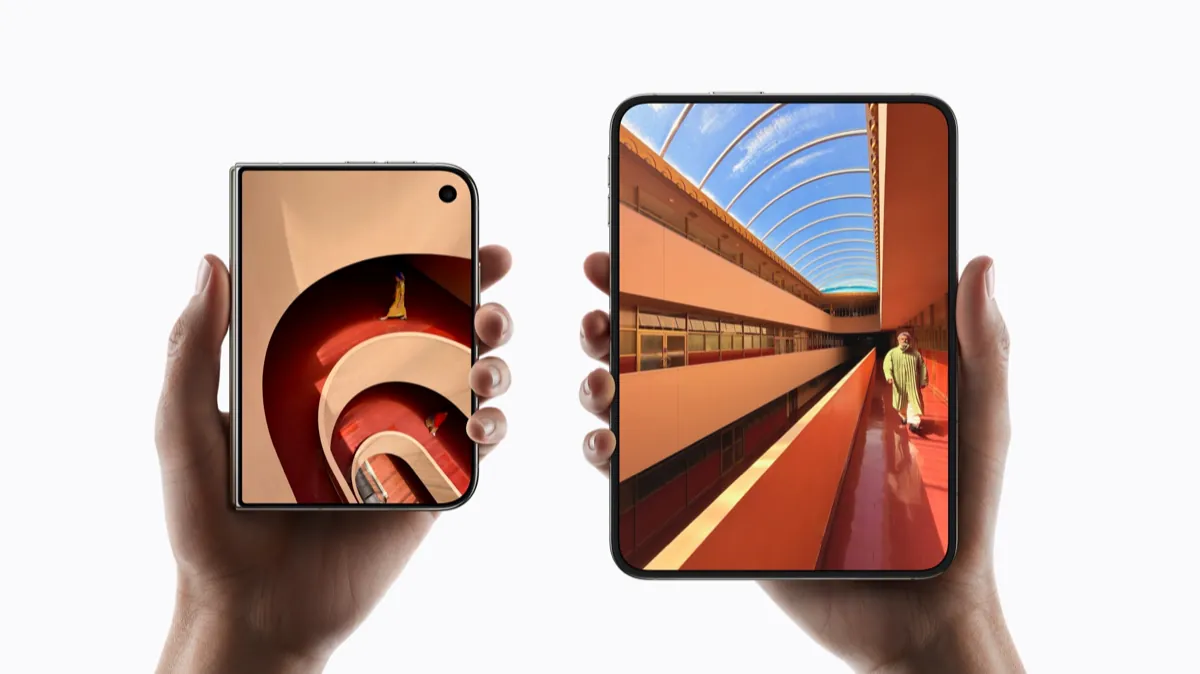
The iPhone Duo crease is the story of this launch. Apple coated the inner display in a nano-texture polymer, a matte layer that Apple says cuts glare and makes the fold harder to see. Gizmodo's Raymond Wong, who spent a few minutes with it at the event, wrote that the inner screen "looks like paper", and that running a finger across it, he couldn't feel the hinge or the plates underneath.
Viewed head-on, the crease "is not visible at all", Android Authority's Aamir Siddiqui wrote after his own short session. From other angles it shows. MacRumors' Juli Clover saw it "in certain lighting", and Wong could still see it "at various angles". Clover added that Apple did a better job than Samsung at hiding it. Those are first impressions of demo units, not tests of daily use. As Clover notes, creases can get more visible as a phone folds and unfolds, so how this one ages is an open question that only months of use will answer. Our durability explainer covers what Apple has and hasn't said about the hinge.
Touch ID, no Face ID, and other design quirks
Folding a phone in half forced some unusual choices:
- Touch ID is back. Apple builds it into the side button and says it works open or closed. There is no Face ID. Wong called its loss "a step backward", though he doesn't think it's a dealbreaker.
- The outer screen is asymmetric. Wong noticed its corners are squared off on the hinge side and rounded on the other.
- The volume buttons sit on the top edge, so they stay in the same place whichever screen you use. TechPP's roundup of hidden details points out that no other iPhone has done this, and Siddiqui wrote that the placement "may take some getting used to".
- There's no Action button, MacRumors notes. The Camera Control button stays.
Camera: strong outside, unknown inside
On the back, the Duo pairs a 48MP Fusion main camera with a 48MP Fusion ultra wide, the same ultra wide as the iPhone 18 Pro, according to Apple. There's no dedicated telephoto lens. Instead, Apple crops the main sensor for 2x optical-quality zoom, and it records 4K at 120 fps in Dolby Vision. If a real zoom lens matters to you, the Xiaomi 18 Fold has one; our iPhone Duo vs Xiaomi 18 Fold comparison weighs that against the rest of the trade-offs.
The open question is the FaceTime camera hidden under the inner screen. It keeps that big display free of a cutout, but light has to pass through the display first. Apple's specs list 1080p video at 30 or 60 fps, and, as MacRumors reports, Apple hasn't said what resolution it is. We found no published photo test of the Duo's inner camera as of September 23, 2026. Siddiqui could spot the change in pixel density over the camera on his demo unit. Android Authority's Hadlee Simons argues the design is a bad idea, using photos from three other phones with under-display cameras to show how far the technology still trails a normal selfie camera. Until someone tests the Duo itself, the 12MP camera on the outer screen, or the rear cameras, is the safer bet for selfies that matter.
Apple also describes a few camera tricks enabled by the fold. Smart Take uses on-device AI to take the photo when your subjects are posing. Duo Preview shows the shot on the outer screen so your subject can see how they're framed, and Kid Cue plays Peanuts animations there to hold a child's attention.
iOS 27 on a foldable
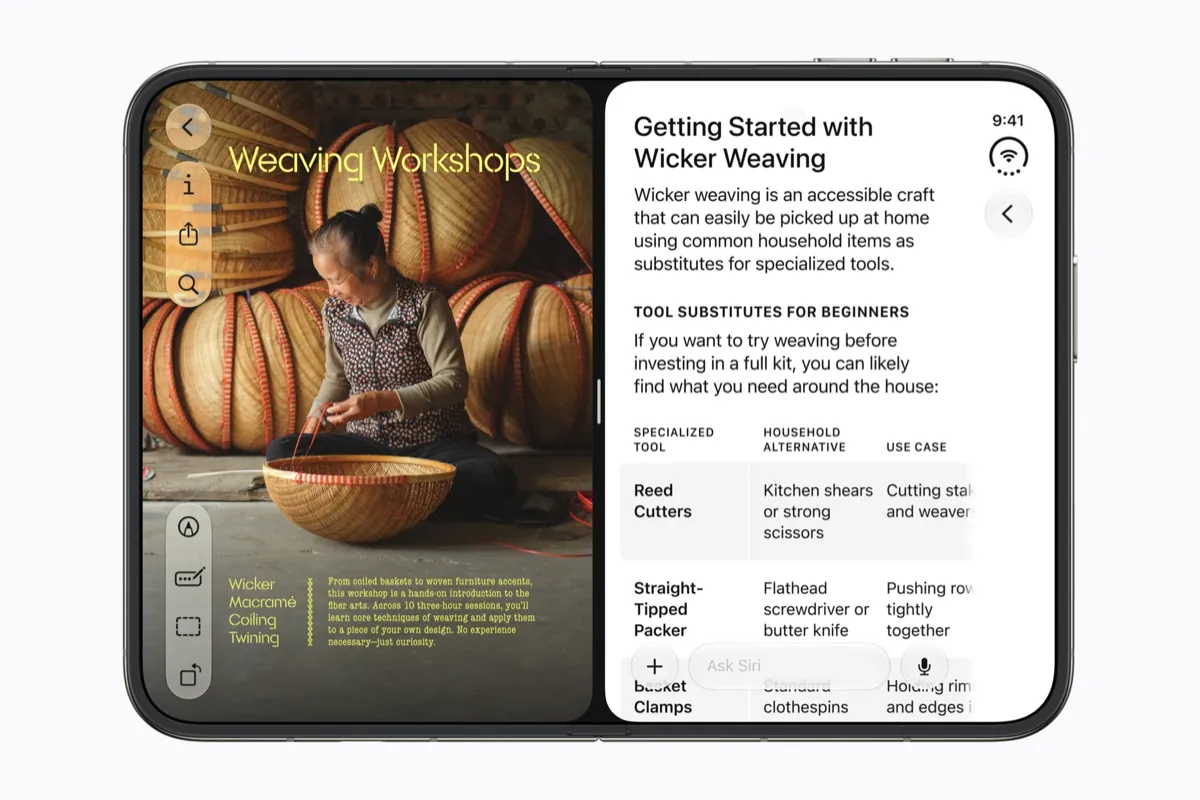
The Duo runs iOS 27, shipping with the 27.1 update, and Apple says the big screen gets features no iPhone has had before. Split View puts two apps side by side, a first for iPhone. The dock moves to a vertical strip on the side, and the Dynamic Island moves to the side to match. You can prop the phone up partly folded, and StandBy works on either screen, even when it isn't charging.
Apple Pencil support, for the USB-C model on either screen, is coming "later this year", Apple says.
iPhone Duo battery life and charging
A battery sits on each side of the fold. Apple claims up to 31 hours of video playback on the inner screen and up to 44 hours on the outer one. Those figures come from Apple's own testing in August 2026 on preproduction units, per the footnotes on its specs page. Charging reaches about 50% in around 20 minutes over USB-C with a 60W-capable adapter, or about 30 minutes on MagSafe, Apple says. We found no independent battery test as of September 23, 2026, so real-world numbers will have to wait for full reviews.
Is it an iPad mini killer?
It's a fair question. The Duo's 7.6-inch screen is close to the iPad mini's 8.3 inches, and once Pencil support arrives, it could cover the same reading, notes and video use. We think it may pull some buyers away from the iPad mini, but that's our guess, not something sales data shows yet. At $1,999 it's not a replacement for anyone who just wants a small, cheap tablet.
Also announced: iPhone 18 Pro and 18 Pro Max
The iPhone 18 Pro gets a main camera with a variable aperture. Six blades switch between four settings, from f/1.48 for low light to f/4 for more depth of field. The Dynamic Island is smaller and can now show three Live Activities at once, and Face ID stays. It comes in black, silver, glacier and a new burgundy.
Both models run the A20 Pro chip and the C2 modem. The iPhone 18 Pro starts at $1,199 and the Pro Max at $1,299 in the US, and both went on sale September 18, per Apple's announcement.
Bottom line
On Apple's specs and the first short hands-on sessions, the iPhone Duo looks like a carefully finished first foldable: Wong wrote that Apple "may have made the most desirable foldable ever created", and Siddiqui expects it to be "one of the most impactful ones". Those are impressions from a few minutes with demo units. Long-term hinge and crease durability can't be tested until the phone has been in use for months, we found no published test of real battery life or the inner selfie camera, and we haven't tested anything ourselves.
What's certain is the iPhone Duo price and the trade-offs. You pay $1,999 or more in the US (MXN 47,999 or more in Mexico), and you give up Face ID and a conventional inner selfie camera. If you want one device for your phone and your tablet, it's worth waiting for full reviews that cover battery and durability before you pre-order. If you'd rather have Face ID and a variable-aperture camera now, the iPhone 18 Pro is on sale for $800 less in the US.
More phones and hardware live in Gadgets, and every story is in the archive.
Updated September 23, 2026: early praise is now attributed to the reviewers who gave it, a dated price table covers the US and Mexico, and a camera claim that rested on a test of other phones is removed, as listed on the Corrections page.
FAQ
How much does the iPhone Duo cost?
In the US, $1,999 for 256GB, $2,199 for 512GB, $2,599 for 1TB and $3,199 for 2TB, before sales tax. In Mexico it ranges from MXN 47,999 to MXN 77,999, IVA included. Both come from Apple's online stores as checked on September 23, 2026.
When is the iPhone Duo release date?
Pre-orders open Friday, October 16. It goes on sale Friday, October 23 in more than 70 countries and regions, including the US and Mexico, and on October 30 in 28 more, according to Apple.
Does the iPhone Duo have Face ID?
No. It uses Touch ID built into the side button, which Apple says works whether the phone is open or closed.
Does the iPhone Duo have a crease?
Yes, but a faint one, according to reviewers who handled it briefly. One couldn't see it head-on at all; others spotted it in certain light or at an angle. How visible it gets after months of folding hasn't been tested yet.
Is the iPhone Duo waterproof?
Not waterproof, but water resistant. Apple rates it IP68, which it defines as a maximum depth of 6 meters for up to 30 minutes.