arXiv submission limit: two papers a month, rejects count
arXiv's new submission limit caps each submitter at two papers a month and three active. What counts, who it hits, and why AI-written papers forced it.
Source-based. Written from the documents, reporting and reviews linked in the text. Nothing here was tested hands-on by The Ruling Desk. How we work
arXiv now has a hard submission limit: since October 1, 2026, each submitter can send at most two papers per calendar month, with no more than three submissions active at once. The open-access preprint server for physics, math, computer science and other fields says a flood of thin, "salami-sliced" and AI-written papers pushed it there. Here is exactly what counts against the arXiv submission limit, what doesn't, and who will feel it.
Key takeaways
- The rule: two submissions per calendar month per submitter, and three active submissions at any time, across every arXiv category, according to arXiv's announcement.
- Rejections count: the cap is on submissions, not announced papers, so a rejected paper uses up one of your two slots. A paper you delete before it's announced does not.
- Only the submitter is counted: co-authors on a paper you submit keep their own two slots.
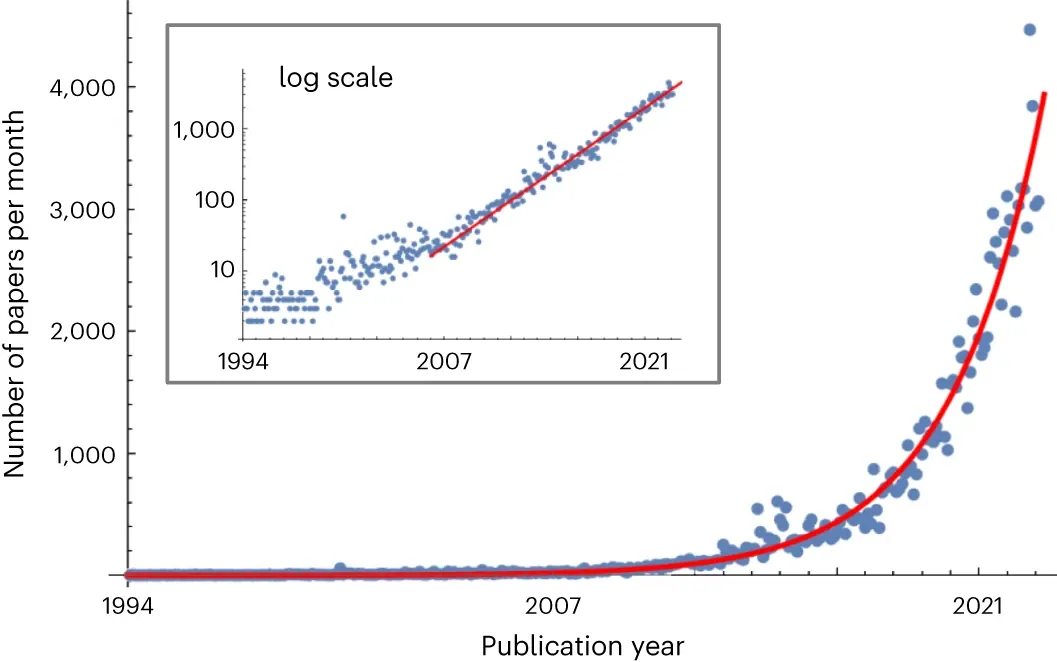
- The numbers: arXiv says it received a record 40,363 submissions in September 2026, against 20,569 in September 2024, and that cs.AI grew more than sixfold in those two years.
- A stopgap, by arXiv's own description: it says it will monitor the effect and change the policy as needed. Replacements (new versions of a paper) are not addressed in its FAQ.
How the arXiv submission limit works
arXiv published the policy on October 1 in a blog post by Kat Boboris, effective the same day. The short version: two submissions per month, three in the pipeline at most. The three-active cap isn't new; arXiv says it has been in place since 2024. What's new is the monthly ceiling, which used to be left mostly to moderators' discretion.
The FAQ in the announcement answers most of the edge cases. Here is what counts, as of October 2, 2026:
| Situation | Counts toward 2 a month? | Counts toward 3 active? |
|---|---|---|
| A paper that is accepted and announced | Yes | While it's pending |
| A paper that moderators reject | Yes | Not stated |
| A paper you delete before it's announced | No | No |
| A paper from last month still "on hold" | Not against the new month | Yes |
| A paper in a different subject area | Yes, the cap covers all categories | Yes |
| A paper you submit for co-authors | Yours only, not theirs | Yours only |
| A replacement (a new version) | Not addressed | Not addressed |
Two details are easy to miss. First, arXiv's moderation help page phrases the rule as "each author may submit up to two submissions", but the announcement's FAQ says "all arXiv rate limit policies apply only to submitters", so a paper with ten authors costs only the person who uploads it. Second, the same help page says arXiv may ask a particular author to limit their rate further.
There is no exception for conferences or backlogs. arXiv's answer to authors with a pile of work or a deadline is to plan their submissions so the limits don't hurt them.
The numbers behind the cap
arXiv gives three September snapshots: 9,869 submissions in 2016, 20,569 in 2024 and 40,363 in 2026, a new monthly record. That's a doubling in two years. The September 2026 volume also generated almost 9,000 support tickets for staff and moderators, arXiv says.
The growth isn't even. According to arXiv, cs.AI submissions rose more than six times over the past two years, while other categories roughly doubled.
Why arXiv blames AI-written and salami papers
arXiv doesn't ban AI. Its policy on generative AI tools lets authors use them if they report significant use and take full responsibility for the result. The problem, the announcement says, is that many new submissions don't meet arXiv's standards of scholarly interest. arXiv moderators, who are volunteer subject experts, report three kinds of paper on the rise:
- Thin papers of narrow scope.
- "Salami" papers, where one piece of work is cut into several smaller submissions.
- Dense, AI-written papers, which arXiv says AI tools make easy to produce in bulk.
Thomas Dietterich, an emeritus professor at Oregon State University who chairs arXiv's Editorial Advisory Council, puts the cost on moderators. In the announcement he says "a relatively small proportion of authors" are sending many low-quality papers and eating a disproportionate share of moderators' time, which delays good papers "for days or weeks". The cap is meant to spread that volunteer time evenly across authors.
This is arXiv's third step in about a year against low-effort submissions. In late 2025 it stopped accepting computer science review and position papers without proof of peer review, as 404 Media reported. In May 2026 it announced one-year bans for papers with clear signs of unchecked AI output, such as invented references, according to The Next Web.
Who the limit hits hardest
A cap of 24 new submissions a year won't bind someone who posts a few papers a year; that's our arithmetic, not arXiv's claim. The people it does bind, on our reading of the rules:
- Whoever uploads for a group. If one person in a lab handles every submission, that person's two slots are now the lab's two slots.
- Authors with a deadline cluster. A burst of conference papers in one month runs into the ceiling, and arXiv offers no exception.
- Anyone who gets rejected. A declined paper still burns a slot, so a borderline submission is now a costlier bet.
- The high-volume authors arXiv is aiming at, who can no longer post a dozen papers in a month under one account.
Peter Coles, a professor of theoretical physics at Maynooth University, wrote on his astrophysics blog, In the Dark, that the reason for the limit is clear, calling submission growth "uncontrolled and alarming". He also expects large collaborations to work around it by having different co-authors submit, which the submitter-only rule allows. And he flagged the open question above: whether replacements count.
What happens next
arXiv calls the policy a stopgap while it works out best practice for authors using AI tools and improves its moderation tools. It says it will watch the effect on authors and readers and "modify as needed". No end date or review date has been announced. How the arXiv submission limit treats replacements is the question to watch, since revising a paper is routine and the FAQ is silent on it. For more on how AI is changing research and the tools around it, see our AI coverage.
Bottom line
Under the arXiv submission limit, plan for two new papers a month under your account, three in flight at most, and count every rejection as a used slot. Delete before announcement if you spot a mistake, since that frees the slot. If you upload for a group, spread submissions across co-authors. arXiv says the cap answers a doubling in submissions and a surge of AI-written and salami papers, and it describes the rule as temporary, so expect changes.
FAQ
Do rejected papers count toward arXiv's monthly limit?
Yes. arXiv says the limit applies to submissions, not announced papers, because every submission takes moderator time. Two rejected papers in one month mean you wait until the next month to submit again.
Does the arXiv limit apply to co-authors?
No. arXiv's FAQ says its rate limits apply only to submitters. A paper with several co-authors counts only against the person who submits it, so co-authors are told to coordinate who uploads what.
Do replacements count toward the arXiv submission limit?
arXiv's announcement and FAQ don't say, as of October 2, 2026. Peter Coles raised the same question on his blog. Until arXiv clarifies, treat it as open.
When did the arXiv submission limit start?
October 1, 2026. Papers deleted before announcement don't count, and papers from September still on hold don't count against October's two, though they do count toward the three-active cap.