Google AI Overviews lawsuits dismissed: why publishers lost
A judge threw out the Google AI Overviews lawsuits from Penske Media and Chegg. Why an expectation of traffic isn't a deal, and what publishers can try next.
Source-based. Written from the documents, reporting and reviews linked in the text. Nothing here was tested hands-on by The Ruling Desk. How we work
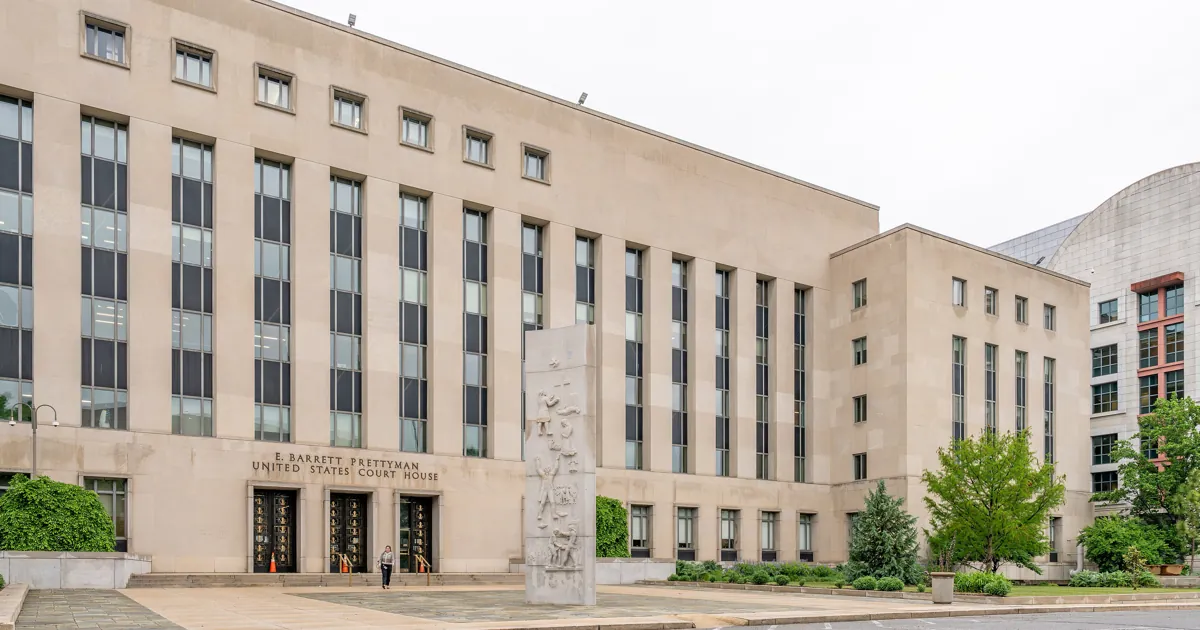
A federal judge in Washington has dismissed the antitrust suits Penske Media and Chegg brought over Google's AI Overviews, ruling that publishers who let Google crawl their sites never struck a deal with it. In a 41-page opinion filed September 30, 2026, US District Judge Amit Mehta wrote that the companies alleged only an "expectation" of search traffic, "but an expectation is not an agreement." Without an agreement, the core of each Google AI Overviews lawsuit had nothing to stand on. Here's what each company claimed, why the theory failed, and what publishers can still try.
Key takeaways
- Both cases dismissed: Judge Mehta of the US District Court for the District of Columbia granted Google's motions to dismiss in Penske Media v. Google and Chegg v. Google on September 30, 2026, in one opinion covering both.
- No deal, no reciprocal dealing: the main claim needed an agreement trading content for traffic. The court found only an expectation, which it called "simply how a general search engine works."
- AI Overviews counts as part of Search, for now: Mehta rejected Penske's claim that Google illegally ties AI Overviews to search, finding no plausible separate demand for the two.
- The door is partly open: Penske's order says the dismissal is "without prejudice"; Chegg's order doesn't use those words. Both orders are final and appealable, and neither sets a deadline to refile.
- Not a copyright ruling: neither company sued for copyright infringement, so the opinion doesn't say whether AI Overviews infringe. Mehta pointed publishers toward Congress and regulators.
What the judge decided in the Google AI Overviews lawsuit
Chegg, the online study-help company, sued Google and its parent Alphabet in February 2025. Penske Media Corporation, which owns Rolling Stone, Billboard, Variety, The Hollywood Reporter and Deadline, followed in September 2025, joined by several of its publications. Mehta, who also presided over the Justice Department's search monopoly case against Google, heard both together on August 25, 2026, and dismissed both in a single memorandum opinion.
The complaints were nearly identical. Each said Google uses its monopoly in general search to force sites to hand over content for free, then reuses that content in featured snippets, AI Overviews and Gemini to compete with them. They pleaded several Sherman Act violations (reciprocal dealing, monopoly leveraging, monopolization and attempted monopolization) plus a California unjust enrichment claim. Every count was dismissed.
Why an expectation is not an agreement
The heart of both complaints was reciprocal dealing, which the opinion sums up as one company telling another "I'll buy from you, if you buy from me." The companies said they "pay" Google with their content and get search traffic back, a "fundamental bargain" Google broke by keeping readers on its results page with AI answers.
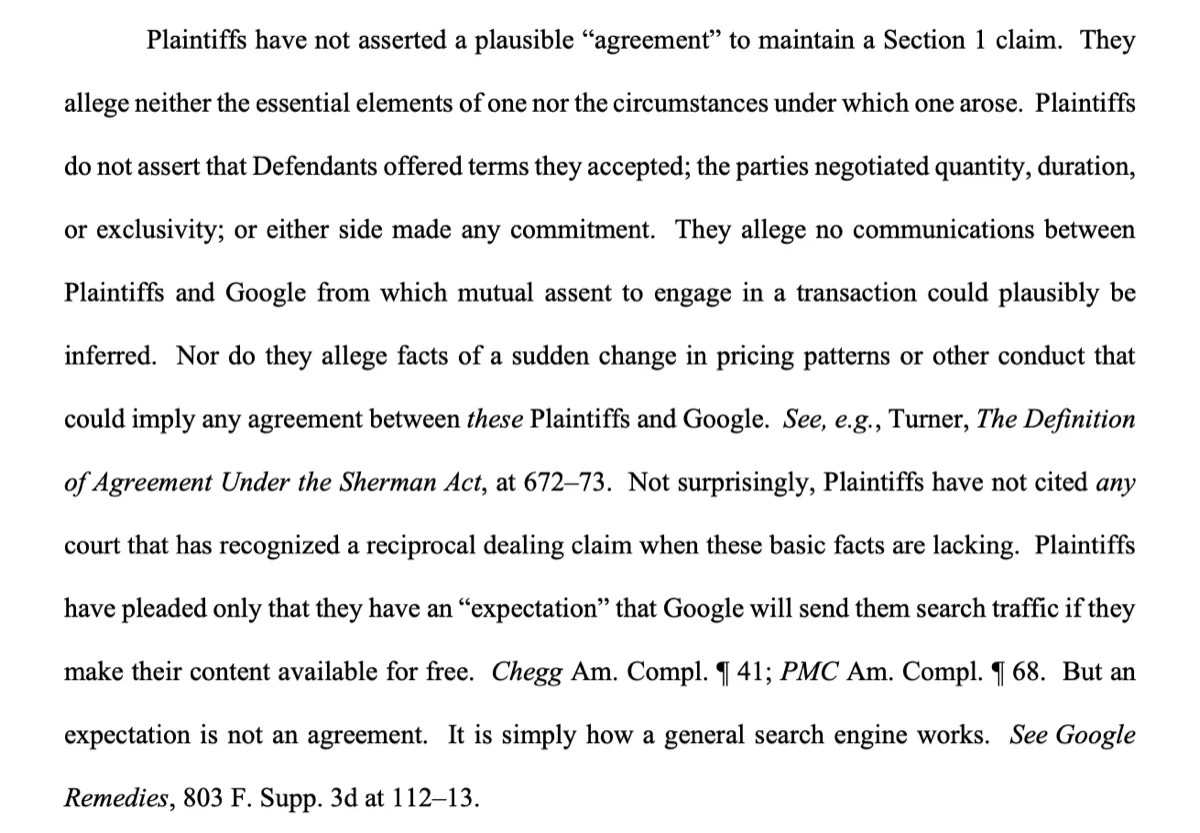
Mehta's problem was the word bargain. A claim under Section 1 of the Sherman Act needs an actual agreement, and the opinion lists what the complaints lacked: no terms offered and accepted, no negotiated quantity or duration, no commitment from either side, and no communications showing both sides agreed to anything. All the companies alleged was that they expect traffic if they leave their content open to crawling. "But an expectation is not an agreement," Mehta wrote. "It is simply how a general search engine works."
He also rejected an implied deal based on years of "historical course of dealing." Publishers keep their sites open because it serves their own interest in traffic, the opinion says, not because they struck a bargain with Google. If the theory were right, Google would have contracts with the billions of sites it indexes, which the court called "entirely implausible." The Section 2 version failed for the same reason: reciprocal dealing takes two sides, and the court found no dealing relationship.
In plain terms, the antitrust theory needed Google to be part of a deal it then cheated on. The court saw a search engine crawling public pages and publishers choosing to let it.
What Penske Media and Chegg each claimed
Penske went further than Chegg on one point. It argued Google illegally ties AI Overviews to general search, making users get an AI summary at the top of results whether they want one or not. Mehta assumed the strictest legal test applied and still dismissed it. By Penske's own account, users satisfied by AI Overviews have little reason to click through, which points to one demand for answers, not two separate products. He also noted that other search engines, DuckDuckGo among them, show AI summaries too. Penske's complaint said its organic affiliate revenue fell by more than a third from its peak through the end of 2024, Press Gazette reported.
Chegg's distinct claim was a market of its own: "Online Educational Publishing," content built for learning. The judge called that market "hopelessly vague" and questioned whether Google even competes in it, since Chegg's own complaint describes AI Overviews as scraped answers without the curation and verification it says define educational content. Penske's "online publishing" market, covering essentially all text published online, was "implausibly overbroad."
Both companies also lost on standing for their monopoly claims. The harms they described, lost subscriptions and unpaid content, happen in publishing markets, not in general search, where Google's monopoly sits. With the federal claims gone, the court declined to rule on the California unjust enrichment claims at all.
What dismissal without prejudice leaves open
Penske's order grants Google's motion "without prejudice," which means the court did not bar Penske from bringing its claims again in a better complaint. Chegg's order grants the motion without saying either way. Neither order sets a deadline to refile. Both are labeled "final, appealable," so either company could instead ask the D.C. Circuit to review the ruling. Under Rule 4 of the Federal Rules of Appellate Procedure, a notice of appeal in a civil case is generally due within 30 days of the judgment.
Refiling won't be easy. To revive the reciprocal dealing claims, a new complaint would need facts showing a real exchange with Google: terms, negotiation, commitments. It's also the second time this year Mehta has turned the theory away. In March 2026, the opinion notes, he rejected similar claims from news publishers in Helena World Chronicle v. Google.
Penske Media, Google and Chegg had not responded to requests for comment, TheWrap reported on October 1.
What it means for publishers fighting AI summaries
The ruling closes one door, antitrust suits built on a content-for-traffic bargain, in the court that decided the government's search monopoly case. Mehta made clear it wasn't for lack of sympathy. The court is not "unsympathetic to the situation publishers now find themselves in," he wrote, but antitrust law is no substitute for lawmakers addressing disruption from new technology. Where the law falls short, he wrote, quoting an earlier case, "that is an issue for Congress [or regulators] to consider."
Other routes remain, and this ruling decided none of them:
- Copyright. Neither company brought a copyright claim, so the opinion says nothing about whether training on or summarizing articles is fair use. Courts are working through that question separately, as in the Thomson Reuters v. Ross ruling on AI training.
- Regulators. The European Commission opened an antitrust investigation in December 2025 into whether Google uses publishers' content for AI Overviews and AI Mode without fair pay or a real way to refuse, CNBC reported.
- Google's own controls. In June 2026, Google began testing a Search Console setting that lets sites opt out of its generative AI search features while staying in regular results, starting with some UK site owners. Google says the setting won't be used as a ranking signal outside those features.
For more on how courts are handling AI and publishers' content, see our AI coverage.
Bottom line
Judge Mehta didn't rule that AI Overviews are fair to publishers. He ruled that letting Google crawl your site is not a contract, so an antitrust case built on a broken bargain has no bargain to point to. Penske can refile, and either company can appeal; watch the D.C. Circuit in the next 30 days, and watch the copyright cases and the EU probe for the questions this case never reached.
FAQ
Why were the Penske Media and Chegg lawsuits dismissed?
The main claims needed an agreement in which publishers traded content for Google's search traffic. Judge Mehta found the companies alleged only an expectation of traffic, not an agreement, so the reciprocal dealing claims failed. The tying, market and standing claims failed on separate grounds.
Can Penske Media and Chegg refile?
Penske's case was dismissed without prejudice, so it can bring the claims again in a new complaint; the order sets no deadline. Chegg's order doesn't say with or without prejudice. Both orders are final and appealable, so either company can also appeal to the D.C. Circuit.
Does the ruling mean AI Overviews are legal?
No. The court ruled only that the antitrust claims in each Google AI Overviews lawsuit were not plausibly pleaded. Neither case raised copyright, and the European Commission's investigation into Google's use of publishers' content is a separate matter.