Gemini 4 Argon: who can use it, price and benchmarks
Gemini 4 Argon is limited to cyber defenders and testers for now. Who gets it next, what it costs after the intro price, and how much its benchmarks prove.
Source-based. Written from the documents, reporting and reviews linked in the text. Nothing here was tested hands-on by The Ruling Desk. How we work
Google announced Gemini 4 Argon on September 30, 2026, its new frontier model, but almost nobody can use it yet. Access starts with cyber defenders in Google's Fairwind Program and a group of trusted testers, while Google takes part in the US government's voluntary pre-release testing. Paid API customers and Google AI Ultra subscribers come next, with no date. Here's who has it, what it will cost once the launch price ends, and how much Google's benchmark lead is worth.
Key takeaways
- Who has it today: trusted cyber defenders in the Fairwind Program and a cohort of trusted testers, according to Google. There's no public API, and Google doesn't say when the Gemini app gets it.
- Who's next: paid Gemini API customers and Google AI Ultra subscribers, then developers, enterprises and consumers more broadly. Google gives no dates.
- Price: $2 per million input tokens and $10 per million output tokens at launch, rising to $4 and $20 after an introductory period with no announced end date. Prices are in US dollars, as published on September 30, 2026.
- Benchmarks: Google says Argon scores 77.9% on DeepSWE v1.1, ahead of Claude Opus 5.5 (74.2%) and GPT-6 Astra (74.1%). These are Google's own numbers, and its table also shows Argon behind on two other coding tests.
- Doubts: Bloomberg reports that some Google employees think Argon does better on benchmarks than in real coding work. Google called that characterization inaccurate.
Who can use Gemini 4 Argon today
In its launch post, Google says Argon is "rolling out to a set of trusted cyber defenders" through the Fairwind Program. It adds that it is "actively engaged" in the US government's voluntary process for pre-release model access, and that it will keep gathering feedback from early testers while it works on guardrails. Google doesn't name the government agency or say how long that process takes.
Fairwind isn't new. Google introduced the program on September 2, 2026, for government agencies, critical infrastructure operators such as hospitals, telecoms and banks, and major technology platforms. Google says it has more than 650 partners, including CrowdStrike, Palo Alto Networks and Wiz, and that members must limit access to their internal security, incident response or penetration testing teams. So unless your job is defending systems at one of those organizations, you can't try Argon today.
For those defenders, Google says it will release Argon "without cyber guardrails," so the model can find, validate and patch vulnerabilities at full strength. Everyone else should expect a version with safeguards against cyber and chemical, biological, radiological and nuclear misuse.
Who gets it next
Google says the wider release will start "with paid API customers and Google AI Ultra subscribers," and later reach developers, enterprises and consumers "as soon as possible." 9to5Google reports the same order. Neither gives a date, and Google hasn't said which Gemini app plans beyond Ultra will get Argon.
If you already use Gemini through a paid API key, you're in the first public group. If you use the free Gemini app, nothing changes for now. Google's post also says nothing about when Argon reaches services built on Gemini, such as the America.gov chatbot that launched a day earlier.
Gemini 4 Argon price after the introductory period
Google lists a launch price and a later one, in US dollars per million tokens. The competitors' prices come from Anthropic's pricing page and OpenAI's pricing page, both checked on September 30, 2026:
| Model | Input | Cached input | Output |
|---|---|---|---|
| Gemini 4 Argon (introductory) | $2 | $0.10 | $10 |
| Gemini 4 Argon (after the intro period) | $4 | $0.20 | $20 |
| Claude Opus 5.5 | $4 | $0.20 | $20 |
| GPT-6 Astra | $10 | $1 | $50 |
Google prices cached input at 95% off the input price. Its footnote gives only the later input and output prices, so the $0.20 cached figure is our arithmetic, assuming the same discount carries over.
The launch price matches GPT-6.1 Sol, which OpenAI kept at $2 and $10 at DevDay, and Anthropic's Claude Sonnet 5.5. The later price matches Opus 5.5. Here's our arithmetic for a job that sends 10 million input tokens and gets 2 million back: $40 on Argon at launch, $80 once the intro period ends (the same as Opus 5.5), and $200 on GPT-6 Astra.
The catch is the missing end date. Google says only that "after the introductory period expires," the $4 and $20 rates apply. If you plan a budget around Argon, plan for the higher price.
How much the DeepSWE lead is worth
Google's headline number is DeepSWE v1.1, a test of long, multi-step software engineering tasks, where it puts Argon at 77.9%.
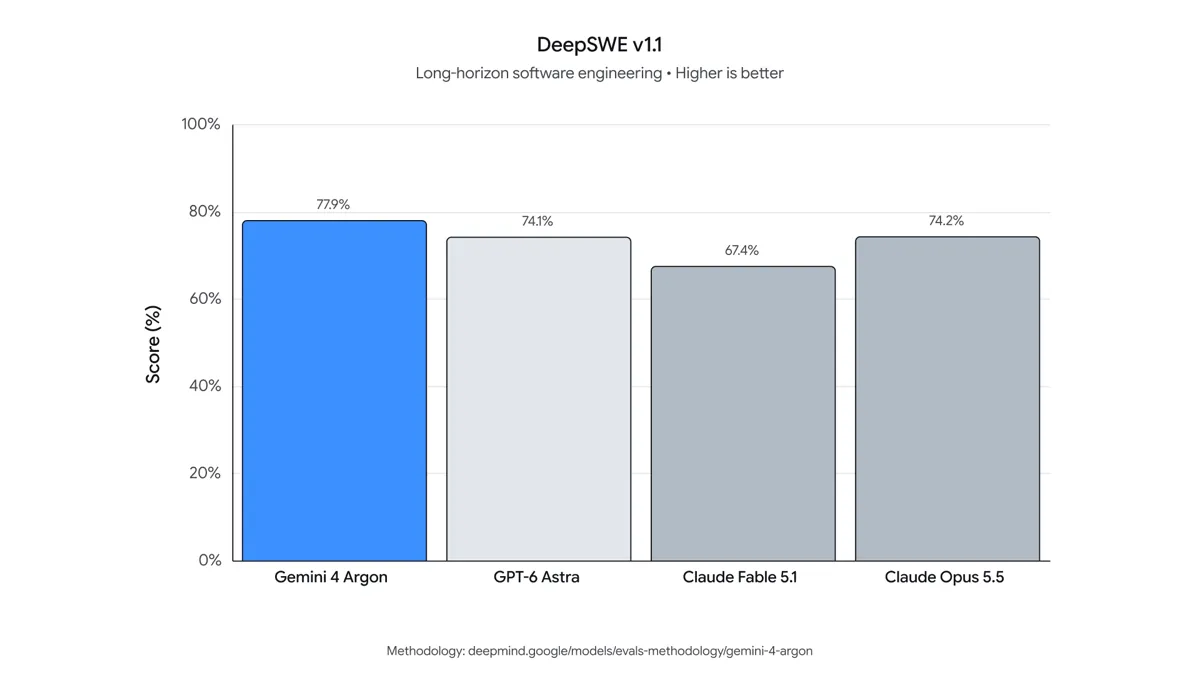
That's a lead of 3.7 points over Opus 5.5 and 3.8 over GPT-6 Astra, on a benchmark Google chose and ran itself. The full table in Google's post is more mixed. VentureBeat counts Argon leading or tying on 13 of the 18 benchmarks listed. On coding alone, the same table shows:
| Coding test (Google's table) | Gemini 4 Argon | GPT-6 Astra | Claude Opus 5.5 |
|---|---|---|---|
| DeepSWE v1.1 | 77.9% | 74.1% | 74.2% |
| Vibe Code Bench | 91.9% | 89.6% | 90.3% |
| FrontierSWE v2 | 55.0% | 65.5% | 62.3% |
| Terminal-bench 4.0 | 57.4% | 58.2% | 66.4% |
So Argon wins two of Google's four coding tests and trails on the other two, by more than 10 points on FrontierSWE v2. The wide margins are elsewhere: 19.6% on Harvey's Legal Agent Benchmark against 5.4% for Astra and 3.8% for Opus 5.5, and 51.3% on Zapier's AutomationBench against 42.5% for Opus 5.5.
Bloomberg reports, citing people familiar with the model, that some Google employees think Argon does well on industry benchmarks but less well on real work, including some coding tasks and front-end design. Google told Bloomberg it would be inaccurate to say the model underperforms at coding, and pointed to earlier comments by Koray Kavukcuoglu, Google's chief AI architect: "In my mind, it's a certainty that we are always gonna be at the frontier." Until outside testers can run Argon, there's no independent way to settle it.
What happens next
Watch for three things: a date for paid API and Ultra access, an end date for the $2 and $10 price, and independent scores once developers can run the model. More AI coverage lives in our AI section.
Bottom line
Gemini 4 Argon is real but gated: today it belongs to Fairwind's cyber defenders and Google's trusted testers. Paid API customers and AI Ultra subscribers are next, with no date. The launch price of $2 and $10 is cheap for a flagship, but budget for $4 and $20, the same as Claude Opus 5.5. Google's DeepSWE lead is its own claim, its table shows Argon behind on two of four coding tests, and Bloomberg's reporting on staff doubts is disputed by Google. Wait for independent results before you switch.
FAQ
Can I use Gemini 4 Argon now?
Only if you're a trusted cyber defender in Google's Fairwind Program or one of its trusted testers, as of September 30, 2026. Google says paid API customers and Google AI Ultra subscribers come next, then developers, enterprises and consumers. It hasn't given a date.
How much does Gemini 4 Argon cost?
Google's introductory API price is $2 per million input tokens and $10 per million output tokens, with cached input 95% cheaper. After the introductory period, it rises to $4 and $20. Google hasn't said when the introductory period ends.
Is Gemini 4 Argon better than Claude Opus 5.5 and GPT-6 Astra?
On DeepSWE v1.1, Google's own figures put Argon at 77.9%, against 74.2% for Opus 5.5 and 74.1% for GPT-6 Astra. The same table shows Argon behind both on FrontierSWE v2 and Terminal-bench 4.0. No independent results were available at launch.